
Seeing the Gap


Declan’s Story
Declan* walked in late. We'd already started—an engaging math warm-up with a low floor, high ceiling challenge. The question was ambiguous on purpose. The kind of question where every mathematician in the room, no matter where they usually sat on a spectrum of "advanced" or "struggling," had room to stretch their thinking.
Declan came in to get “his” student. That's how he thought of her—his. Declan was our learning support teacher, and like a lot of paraprofessionals, he'd built his whole practice around a caseload of students that he believed only he could/should work with. His routine was just that, routine: Pull the student out, work with her quietly, one-on-one (or occasionally in a small group of like-students) in a space where he could control the pace, the noise, and the challenge.
When Declan walked in to get Isla*, he found her deep in conversation with one of the kids our entire team would have quietly called one of our strongest mathematicians. They were engaging with the question, using manipulatives, and building on each other's thinking. They were both genuinely stuck, genuinely working it out, genuinely fine.
He stood a few steps away and didn't move. I could see the questions flooding through his thoughts: How is she having this conversation? How are they working together? How is she not feeling bad about herself?
Declan watched for a long time before I went to talk to him. And somewhere in that watching, something shifted. He told me, with a pause, that he thought he'd been doing her an injustice. “Maybe she needs this,” he whispered. “I get it.”
Pulling her out of class, the thing Declan had done without question—despite pushback from the team—wasn’t protecting her. It was the exact opposite. It was keeping her from the kind of deep, ambiguous, high-expectation thinking she'd just shown him she could do. It kept Declan from the thing the rest of our team had been trying for months to build.
I wish I could tell you we fixed everything that afternoon. We didn't. That year moved on the way years do. But something had cracked open in him, and it didn't fully close. The next year, after Declan left the team, the person who replaced him inherited something different—a team with a defined vision and clear essential agreements. As a team, we created the backbone that would have stopped many debates the year before. The vision and agreements would have served as a gateway for Declan before the doorway moment revealed it to him.
Experience and hindsight have taught me so much. In this case, I’ve learned that story about Declan and Isla wasn’t really a story about knowing students. It was a story about what happens when a team doesn't have a shared vision, and doesn't have real trust in each other's ability to serve every student well. Declan didn't distrust me. He distrusted the idea that anyone but him could serve Isla—because nothing had ever told him otherwise.
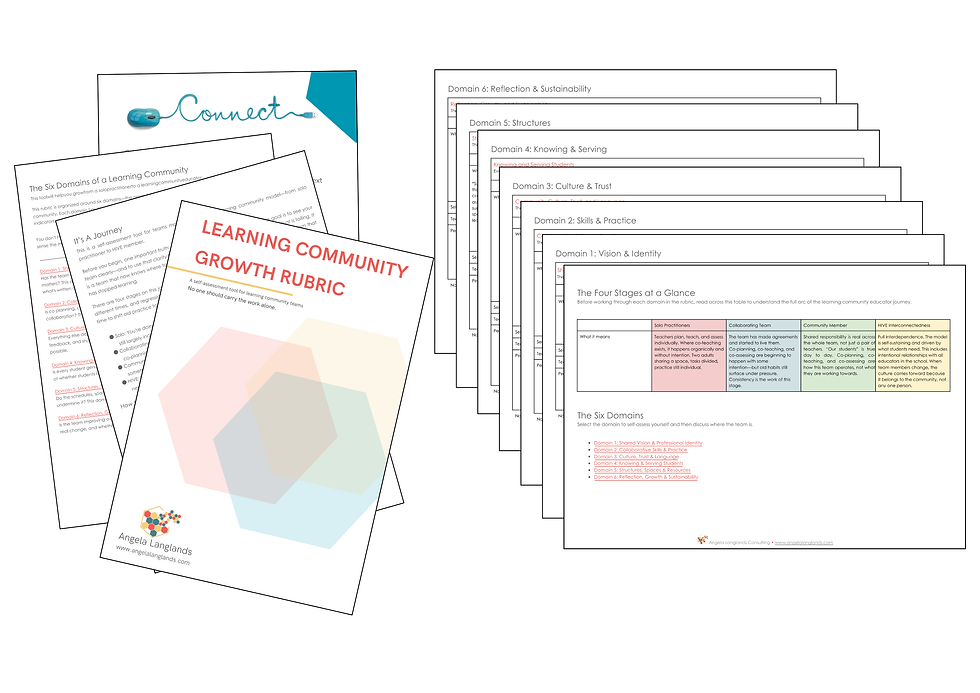
The Learning Community Growth Rubric
That story is part of the transformation I’ve done as a learning community educator and coach. It also serves as a reason why I built the Learning Community Growth Rubric—a self-assessment tool for teams moving through the learning community model, from solo practitioner to full interdependence in the HIVE (or hub or village… whatever your school calls it).
The rubric is organized around four stages that work as a continuum, not a ladder:
Solo: You're doing good work, but mostly alone. Planning, teaching, and knowing students are still largely individual responsibilities, even if you're friendly with your team.
Collaborating: You're working with others intentionally, but maybe only one person on your team. Agreements are being made and kept, co-planning is happening, but old habits still surface under pressure.
Community: Shared responsibility is real. "Our students" is genuinely true, day to day—not just something said in meetings. The team moves and decides together. All students are at the core of discussions.
HIVE: Full interdependence. The team is self-sustaining, resilient, and driven by what students need. The culture carries forward even when people leave.
One thing to know about this rubric before you use it…the goal of this tool isn't to reach HIVE. The goal is to see your team clearly—and use that clarity to grow. A team that's honestly “Solo” isn't failing. It's a team that now knows where to start. A team that calls itself HIVE without evidence has stopped learning.
Also… you won't sit neatly at one stage. My own teams moved between Collaborating, Community, and HIVE depending on the subject area, the week, the schedule we had little control over, or our understanding of student needs. Sometimes the language was there—"our students," real co-planning—and then someone would say I need to be with this specific group, and we'd slide back. Other times, we’d slide back on the rubric because improvement meant we also knew there was so much more we could be doing.
That's not failure. That's what the rubric expects.
Six Domains
The rubric looks across six areas that matter most in building and sustaining a learning community:
Vision & Identity: Has the team moved from "individual teachers" to a collective sense of who they are and why this work matters?
Collaborative Skills & Practice: Is co-planning, co-teaching, and co-assessing genuinely shared, or still divided work dressed up as collaboration?
Culture, Trust & Language: The relational conditions everything else depends on.
Knowing & Serving Students: Is every student authentically known by the whole team, or only by one adult?
Structures, Spaces & Resources: Do the schedules and systems actually enable the model, or quietly undermine it?
Reflection & Sustainability: Is the team improving over time, and would the culture survive if people left?
You don't have to work through all six in one sitting. Start where your team has the most energy—or where you sense the most growth is needed.
Where I'd Suggest You Start
If I could point every team toward two domains first, it would be Vision & Identity and Culture, Trust & Language. Not because they matter more than the others—every domain in this rubric earns its place—but because they're the most accessible starting points for most elementary teams. I also suggest these two because, as that math class with Declan taught me, almost nothing else holds without them.
Here's a preview of both.
This is a preview of the Learning Community Growth Rubric—Domains 1 and 3 (of 6). If this resonates with your team, the full rubric is available as an à la carte or part of the Beginning-of-Year Toolkit available for purchase.
Domain 1: Vision & Identity

The team has a clear, co-created sense of why this work matters and who they are together. Teaching identity has shifted from individual to collective.
At Solo, each teacher operates with their own sense of purpose—"my students, my class" is the default, and role identity defines who's responsible for which student. At Collaborating, the team has begun articulating a shared vision, though day-to-day decisions still default to individual priorities. At Community, a shared vision actually guides how the team plans, teaches, and talks about students—"our students" is the norm, not just meeting language. At HIVE, the vision is so embedded it no longer needs to be stated; it simply shows up in every decision the team makes.
Domain 3: Culture, Trust & Language

The relational and cultural conditions that make everything else possible. Trust is not assumed—it is built through consistent language, honest feedback, and shared norms.
At Solo, the team is professionally cordial, but trust is thin—language defaults to "my students," "my room," and students aren't yet a shared responsibility. At Collaborating, trust is building, but old language and habits still slip back under pressure. At Community, trust is strong enough that disagreement is productive rather than threatening, and families hear a consistent, collective picture of their child from the whole team. At HIVE, the culture is simply present—new members are absorbed into the model, and no single adult can be identified as the "owner" of any child's learning.
What to Actually Do This Week
You don't need the whole rubric to start. You don't need every domain, every stage, every checkbox filled in.
Here's the smallest real step: sit down with your team and name your vision for what you're building. Agree on one or two essential agreements about how you'll work with and speak about students. And practice the language shift from mine to ours by creating just one real opportunity for a student to be taught by more than one adult—one subject, one unit, even once this year.
That's it. That's two sets of eyes on one student instead of one. It's small. It's also exactly how the shift starts.
Then, assess yourself on one of the rubric domains. Discuss with your team where everyone sees the unity of the team. Come back to this mid-year. Check again at year's end.
That's not extra work—that's the growth becoming visible.
You're Not Alone
As a thank-you for trying it, anyone who downloads and prototypes the Learning Community Growth Rubric is welcome to two complimentary 30-minute sessions with me—to talk through how it's working for your team, troubleshoot the rollout, or adapt it to your context. No strings attached. Just email me.

*names changed to protect anonymity
Note: This post was edited with AI as an assistant to refine structure and readability. My ideas, voice, and words remain intact.


Comments